October was a month where the headlines and the portfolios told two different stories. The headlines were about central banks turning hawkish, technology stocks selling off, and gold having its worst month of the year. Beneath that, Canadian equities quietly finished the month ahead, bond yields eased from their early-October highs, and corporate earnings on both sides of the border held up well. We cover the main developments below, and most importantly, what they mean for how your portfolio is positioned. We have also added a note on the U.S. midterm election results, which arrived as this update was being finalized.
Markets in Brief
October’s defining feature was rotation. Capital moved out of growth and technology and into the more traditional corners of the market: financials, energy, industrials and dividend payers. That favoured Canada. The Toronto Stock Exchange (TSX) finished the month modestly higher and remains ahead of the S&P 500 for the year, while the tech-heavy Nasdaq fell more than 5% as the AI trade cooled. [1] The composition that held the TSX back during the years of U.S. technology leadership is this year’s tailwind, and it is the same composition we have deliberately kept in client portfolios.
The last trading day of the month was a sharp one lower on both sides of the border, and the S&P 500’s respectable year-to-date figure masks a bumpy ride that included a near-9% spring drawdown. [1] [2] We mention this not to alarm but to make a point: calendar-year returns look smooth in hindsight and rarely feel that way in the moment. Diversification across geographies and sectors has done its job this year, and we have no plans to abandon it.
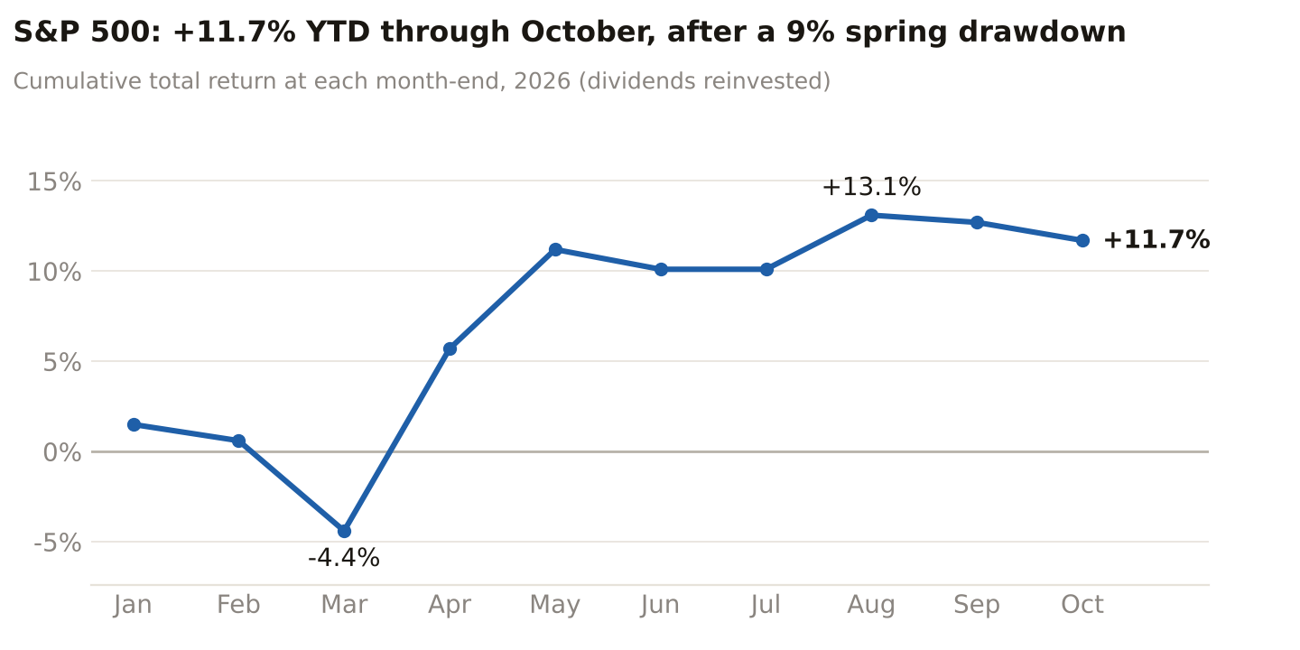
Figure 1. S&P 500 cumulative total return by month-end, 2026 (SPY proxy, dividends reinvested). The index peaked at +15% in early October before giving back ground as technology sold off; the March low was the year’s deepest point. Source: ChartRow, data through Oct 30, 2026. [2]
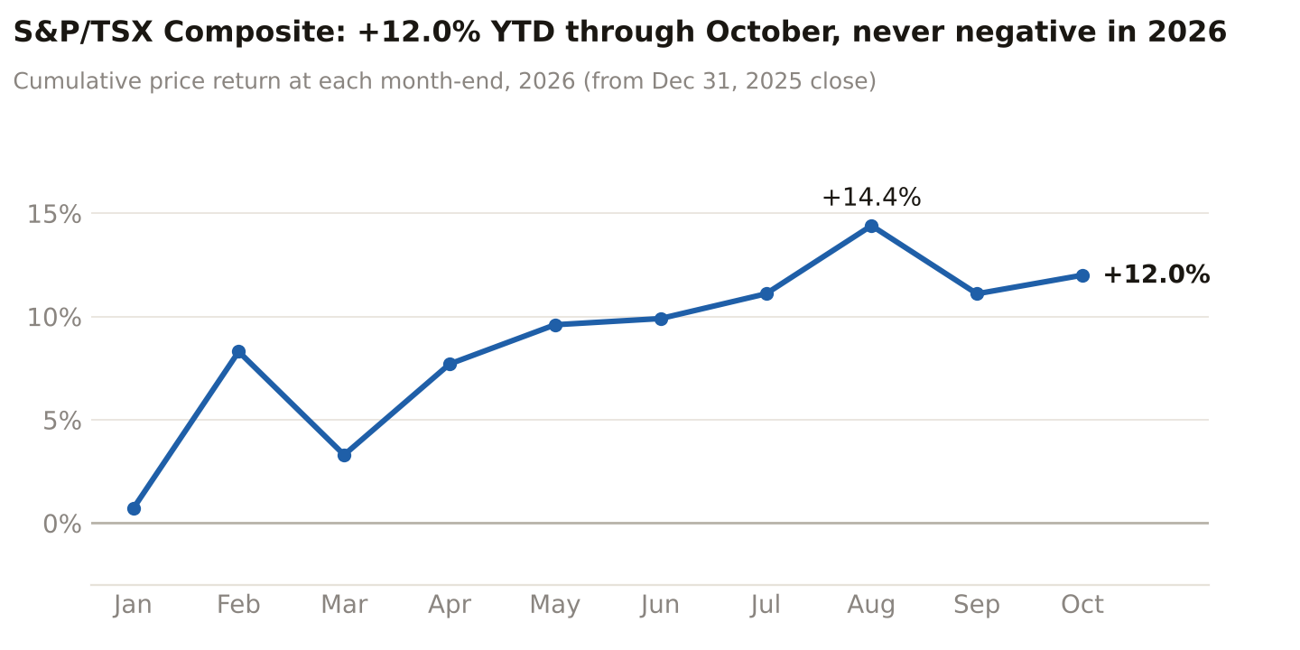
Figure 2. S&P/TSX Composite cumulative price return by month-end, 2026. The TSX has been the steadiest of the three indices this year: its worst month-end (January) was still slightly positive, and it recovered from the March sell-off faster than its U.S. peers. Monthly points are assembled from several published sources and may differ slightly from an official index series. Sources: [1] [20]
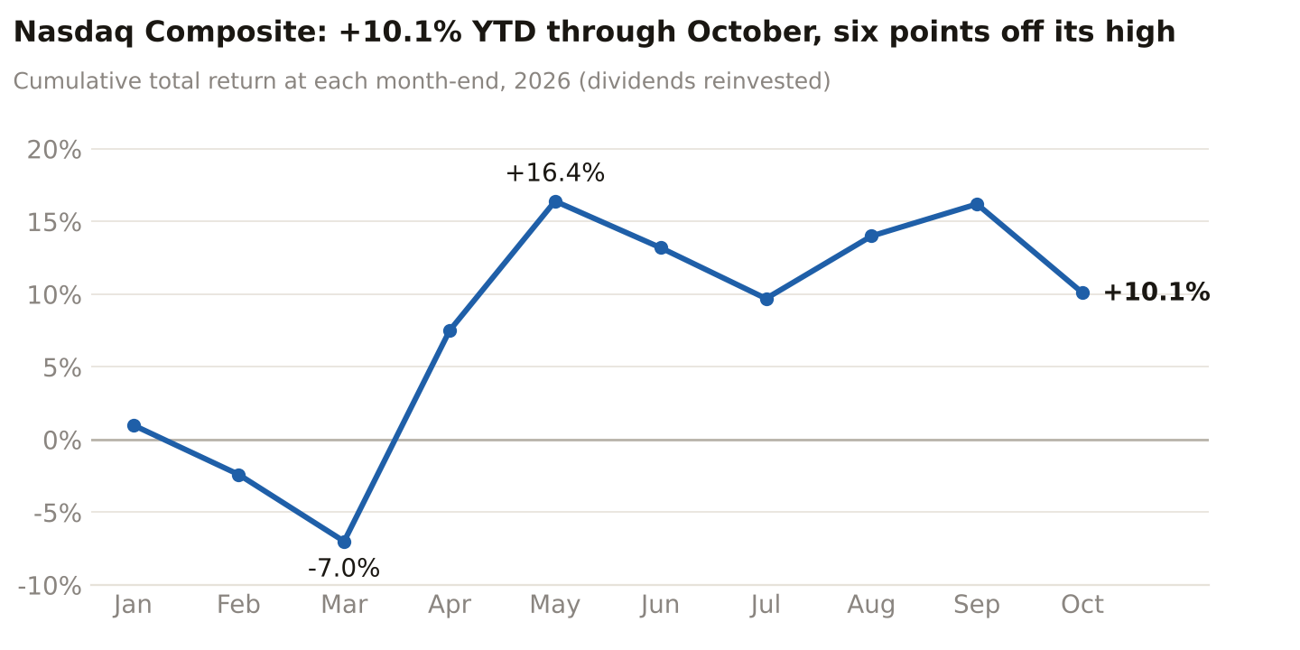
Figure 3. Nasdaq Composite cumulative total return by month-end, 2026 (ONEQ proxy, dividends reinvested). The Nasdaq’s path shows the AI trade in one line: the deepest spring drawdown of the three, the strongest rebound, and the sharpest October pullback. Source: ChartRow, data through Oct 30, 2026. [21]
Interest Rates & Inflation
On October 28, the Bank of Canada raised its policy rate by 25 basis points to 2.50%, its first increase since July 2023 and the end of seven consecutive holds. The big banks moved prime to 4.70% the next day. [3] The Bank’s reasoning was straightforward: headline inflation has been running around 3% since April and is expected to reach roughly 3.5% by year-end on the back of persistently high oil prices. Excluding gasoline, inflation was a more comfortable 2.2% in September, and core measures remain close to 2%. But the Bank’s surveys suggest businesses that have been absorbing higher fuel and input costs will begin passing them on over the next year, and it acted to keep that from spreading. [4] The statement left the door open to further increases, while promising to proceed carefully. [4] In our opinion, this rate increase was a mistake from several angles, and puts more pressure on a strained economy and consumers who have little room to reduce spending.
Statistics Canada’s September CPI reading of 3.1%, released October 19, confirmed the picture: gasoline was up nearly 28% year over year, while grocery inflation continued to slow. [5]
South of the border, the U.S. Federal Reserve held its target range at 3.75% to 4.00% on the same day, following its own September hike. Two members dissented in favour of another increase, and Chair Kevin Warsh described the economy as expanding at a strong pace with inflation still elevated. Markets are pricing one more U.S. hike before year-end. [6] [7]
For bond investors, the picture improved modestly during the month. The Government of Canada 10-year yield touched a three-year high above 4% on October 1, then eased to the 3.8% to 3.9% range as weaker employment data and the sell-off in technology stocks drew money back into government bonds. [8] The U.S. 10-year Treasury remains near multi-decade highs at roughly 4.9% to 5.1%. [9] Higher yields are uncomfortable on the way up, but they mean the fixed-income side of a balanced portfolio is once again earning its keep. GICs and short-to-mid-term bonds are paying rates we have not seen in years.
The Canadian Economy
The Canadian economy has been more resilient than feared, though the trade file remains the dominant source of uncertainty. The Bank of Canada noted that GDP grew 3.3% annualized in the second quarter and about 2% in the third, stronger than it had projected in July. Consumer spending has held up, business investment rebounded on oil and gas activity and equipment purchases, and exports overall have strengthened despite ongoing weakness in tariff-affected sectors. The unemployment rate has sat around 6.5% for several months. [4]
The Bank now expects growth of 1% for 2026 and 2% in each of 2027 and 2028, a modest upgrade from July, with a slowdown expected in the current quarter owing to new U.S. tariffs before activity picks up again next year. [4] The Parliamentary Budget Officer is somewhat less optimistic, projecting 0.9% growth this year and 1.5% next, and a federal deficit of $63.3 billion for 2026-27. The PBO’s downgrade followed the breakdown in Canada-U.S. trade talks at the end of August and the round of tariffs and counter-tariffs that came with it. [10]
Two events this week will shape the near-term outlook: the federal budget on Thursday, which markets will scan for growth measures and the deficit path, and the October labour market report on Friday. [11] We continue to favour positions in Canadian companies with durable earnings and pricing power that are less directly exposed to the manufacturing and resource export sectors most affected by trade volatility.
Oil, Gold & the Canadian Dollar
Oil remains the thread running through everything else in this update. The conflict in the Middle East is now in its eighth month with no clear path to resolution, and Brent crude spent most of October above US$100 per barrel, with WTI near US$100 in the second half of the month. [4] [12] Attacks on Saudi energy infrastructure and Red Sea shipping concerns kept prices near five-month highs. [13] In spite of this, reporting at the start of October found that crude exports from the region were at 80% of their pre-war capacity, but crucially, more refined fuel product exports have only recovered to 60% of their pre-war levels. [i] This pinch in refined fuels has highlighted the importance of refinery capacity versus production capacity of crude as critical to energy pricing. For Canada, this cuts both ways: energy producers and the TSX benefit, while consumers and the Bank of Canada’s inflation outlook do not. Prices did pull back sharply in the final days of the month, which is worth watching: a sustained decline would ease the inflation pressure that prompted October’s rate hike.
Gold had its sharpest monthly loss of 2026, falling about 6.5% in Canadian-dollar terms to close near C$5,416 per ounce and touching a one-year low. [14] The prospect of further central-bank tightening, which raises the opportunity cost of holding a non-yielding asset, was the main driver. We view this as a healthy correction after an exceptional run rather than a change in the long-term case for holding some gold as a diversifier.
The Canadian dollar strengthened over the month, finishing around 71 U.S. cents and extending its gains after the Bank of Canada’s rate increase. [4] [15] Higher oil prices and a narrower rate gap with the U.S. supported the loonie against a U.S. dollar that opened October near its 2026 highs. [16]
Artificial Intelligence
The AI trade had a difficult October, and the reason is instructive. The businesses are still growing at a remarkable pace: Nvidia reported quarterly revenue of US$96 billion, more than double a year earlier, and guided to US$108 billion next quarter. [17] Microsoft’s Azure cloud business grew 48%. [18] What changed is the market’s patience with the spending required to get there. Alphabet, Amazon, Meta and Microsoft have now outlined more than US$740 billion in combined capital expenditure for 2026, and investors have begun to ask harder questions about when those dollars turn into profits. [19]
The late-October earnings reports crystallized the debate. Microsoft trimmed its capex forecast to US$170 billion from US$175 billion, citing delays from third-party chip providers that will push some capacity into 2027, and Alphabet held its guidance at US$195 to 205 billion. Despite beating on earnings, both saw shares react cautiously. [18] Amazon fell about 7% after its results, and the Nasdaq finished the month down more than 5%. [1] [19] Of note, several neo-cloud companies (AI-purpose built data centres) saw significant declines in their stocks, largely due to enormous debt loads.
Finally, one of the most anticipated initial public offerings (IPOs), Anthropic, was found to be showing significant revenue losses all while committed to significant data-centre leases, causing additional concern across the AI industry.
Our view on the theme has not changed: the infrastructure build-out underpinning AI is real and growing, but not without concern. What October demonstrated is that the market will increasingly separate companies with visible returns and positive cash flow from those whose spending is running ahead of revenue. That is a healthier market, not a weaker one, and it rewards the selectivity in picking.
The U.S. Midterm Elections
Americans voted on November 3, and the result was a Democratic sweep: the party took control of both the House of Representatives and the Senate, ending unified Republican control of Washington for the final two years of the president’s term. [25] For the next two years, the U.S. will have a divided government, with the White House and Congress held by different parties.
Markets have greeted the outcome with relief. After a brief sell-off overnight, the Dow Jones Industrial Average rose roughly 1,000 points on November 4, the S&P 500 gained about 1.5% and the Nasdaq about 2%, while the VIX volatility index fell by nearly a fifth. The S&P/TSX Composite climbed almost 500 points to about 36,000, and the Canadian dollar rose to a seven-week high near 71.7 U.S. cents. Oil fell about US$3 to roughly US$93 per barrel, gold rebounded more than US$100 to about US$4,050, and the U.S. 10-year Treasury yield slipped to around 4.9%. [26] [27] [28]
Why the relief? Markets generally prefer divided government, because it makes sweeping new legislation less likely. Strategists quoted by Reuters expect gridlock to restrain spending and put further tax cuts on hold, which is modestly supportive for bond yields, and the resolution of the election itself removed a source of uncertainty that had been hanging over October. [28] The one sector where the result adds scrutiny rather than removes it is technology: a Democratic Congress is expected to look more closely at AI investment, data-centre expansion and the largest platforms, which was the initial cause of the overnight dip in Nasdaq futures before cooler heads prevailed. [26] [28] From our perspective, while we do not foresee drastic changes in the regulation of the AI industry, we remain clear-eyed about the industry fundamentals, namely, spending fueled by debt and the weighing need of gains from the technology to support further spending.
For Canadian investors, we would caution against reading the result as a turning point on trade. Tariffs were imposed under executive authority, and that authority has not changed hands. Senator Susan Collins of Maine, one of the more consistent Republican voices against the Canadian tariffs, lost her seat, so Canada has arguably lost an advocate even as the broader political mood shifted. Offsetting that, the president said on election night that a deal with Canada was imminent, and Prime Minister Carney has said the two sides have made progress after the U.S. backed away from some of its demands. [29] We would treat both as encouraging but unproven until something is signed, and our positioning on tariff-exposed sectors is unchanged.
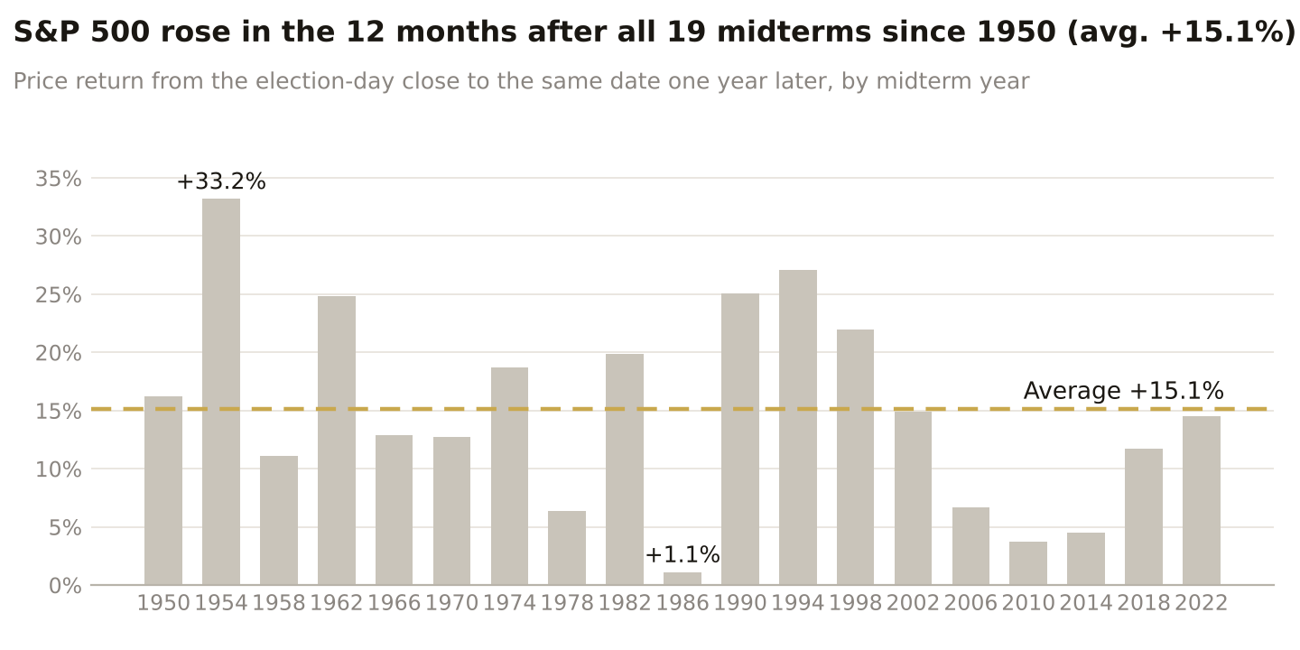
Figure 4. S&P 500 price return in the 12 months following each U.S. midterm election since 1950, measured from the election-day close. History is on the side of patience after a midterm: the index has been higher one year later in all 19 cases, and 2026 now begins its own 12-month window; though the spread runs from +1.1% (1986, a window that included the 1987 crash) to +33.2% (1954), and strong pre-election years like 2026 have tended to see smaller post-election gains. Past performance does not predict future results. Source: SimianX, from Yahoo Finance and CNBC daily closes, updated Oct 15, 2026; corroborated by Opening Bell Daily and YCharts. [22] [23] [24]
Our Positioning and Outlook
Our guiding principle through this period remains quality with resilience. We have not made dramatic changes to portfolios, and October reinforced why: the positions that feel unexciting in a bull market, Canadian dividend payers, high-quality fixed income, a modest gold allocation and international developed-market exposure, are the ones that steadied portfolios when the market’s leaders stumbled. Reactive trading in volatile markets tends to do more harm than good, and we would rather be positioned for a range of outcomes than bet on one.
A few specific observations on how we are positioned:
- We continue to favour Canadian and international companies with durable earnings and pricing power over the most expensive U.S. growth names. Our AI exposure is held through diversified, quality-focused positions rather than concentrated bets, which is exactly the kind of exposure we want when the market starts distinguishing spenders from earners.
- Fixed income. With the Government of Canada 10-year near 3.9%, the bond side of a portfolios is starting to earning its keep. We are comfortable with short-to-mid-term maturities and are in no hurry to extend duration while both central banks are leaning hawkish.
- Real assets. We view gold’s October correction as healthy after an exceptional run, not a reason to abandon it as a diversifier. Energy exposure through the TSX continues to provide a natural hedge against the oil-driven inflation that is shaping central-bank policy.
What we are watching closely: the direction of oil prices, which now sit at the centre of the inflation and rate story on both sides of the border; whether the Bank of Canada follows October’s hike with another in December; the Canada-U.S. trade file, where the midterm result changes the mood more than the mechanics, and Thursday’s federal budget; and the AI earnings cycle, where the market is increasingly rewarding visible returns over spending announcements.
With the U.S. midterms behind us, November still has a full calendar: Canada’s federal budget, the October jobs report, the next CPI reading on November 16 and the Bank of Canada’s December decision after that. Any one of these could move markets in the short term. None of them changes the fundamentals of a well-built plan.
If you have questions about your portfolio or your plan, or if anything in your circumstances has changed, please reach out. We are always glad to hear from you.
Sources
- TSX outpaces S&P 500 as Nasdaq rout puts tech stocks on the back foot — Investing.com, Oct 30, 2026
- S&P 500 YTD Return 2026 — Chartrow, through Oct 30, 2026
- Bank of Canada Policy Interest Rate Schedule 2026 — nesto.ca
- Text of the Bank of Canada’s policy interest rate decision — The Canadian Press / BOE Report, Oct 28, 2026
- Canada Inflation September 2026: Gas Costs Outpace 3.1% CPI — Statistics Canada release summary, Oct 19, 2026
- Federal Reserve issues FOMC statement — Federal Reserve Board, Oct 28, 2026
- Fed’s Interest Rate Decision: October 28, 2026 — Seeking Alpha
- Canada 10Y Bond Yield Hits 5-week Low — Trading Economics, Oct 15, 2026
- Canadian Dollar Update, October 20, 2026 — Knightsbridge FX
- Economic and Fiscal Outlook – October 2026 — Parliamentary Budget Officer, Oct 20, 2026
- Post rate hike spotlight in Canada turns to federal budget, trade and jobs — RBC Economics, Oct 30, 2026
- Oil Price Update October 2026: Brent Leads, WTI Stalls — Oil & Gas Storage News
- Gold edges higher in Canadian dollars as oil-led inflation fears cap metals — Gold Stock Live, Oct 21, 2026
- Monthly Precious Metals Recap & Outlook — October 2026 — Gold Stock Canada
- Canadian dollar extends monthly gain as higher oil prices raise inflation risk — The Globe and Mail / Reuters, Oct 30, 2026
- Canadian Dollar Forecast – October 2026 — MTFX Group
- AI chip stocks bounce back as hyperscaler earnings loom — Yahoo Finance, Oct 20, 2026
- AI buildout hits snag as Google and Microsoft put off raising capex forecasts — CNBC, Oct 29, 2026
- AI Capex Tops $740B as Markets Doubt the Boom — Shattered.io, citing TechCrunch, Nov 2, 2026
- S&P/TSX Composite monthly data — PortfoliosLab (Jan–Apr); Co-operators/Morningstar market recap, May 29, 2026; CEIC (Jun, Sep month-end levels); S&P Dow Jones Indices (Jul YTD); The Globe and Mail, Oct 2, 2026 (Sep)
- Nasdaq Composite YTD Return 2026 — ChartRow, through Oct 30, 2026
- Stock Market After Midterm Elections: Every Cycle 1950–2026 — SimianX, updated Oct 15, 2026
- The S&P 500 rose in the year after all 19 midterm elections since 1950 — Opening Bell Daily, Oct 17, 2026
- 2026 Midterm Election: How Do Markets Historically Respond? — YCharts, Oct 2026
- Democrats win control of the House and vow to keep Trump in check — NBC News, Nov 4, 2026
- Stock Market Today (Nov. 4, 2026): Nasdaq climbs as Democrats take House and Senate — Yahoo Finance
- S&P/TSX composite up nearly 500 points after Democrats take control of U.S. Congress — The Canadian Press / BNN Bloomberg, Nov 4, 2026
- Stocks rally, dollar dips after Democrats’ midterm sweep — Reuters via Investing.com, Nov 4, 2026
- Tariff relief for Canada not guaranteed after Democrats sweep U.S. midterm elections — BNN Bloomberg, Nov 4, 2026
[i] Gulf Oil Exports Recover to 81% of Pre-War Levels | OilPrice.com
Aligned Capital Partners Inc. (“ACPI”) is a full-service investment dealer and a member of the Canadian Investor Protection Fund (“CIPF”) and CIRO. Investment services are provided through Momentum Wealth, an approved trade name of ACPI. Financial planning and insurance services are provided through Momentum Financial Services Inc., an independent company separate from ACPI/Momentum Wealth. This commentary is for general information only and does not constitute investment advice or a recommendation to buy or sell any security. Market data is as of October 30, 2026 unless otherwise noted; election-day market figures are intraday as of November 4, 2026. All figures are subject to revision.