Written by Peter Sproule, Associate Portfolio Manager, CFP, CIM, CLU, CHS & Rosanna Palmieri, Investment Advisor, CEU
As we enter the final stretch of winter and are teased with spring weather, we write to share our perspective on a quarter that has begun with considerable momentum and has more recently had developments that demand some context. As of this writing (March 9th, 2026), Q1 of 2026 has brought encouraging signs across a number of fronts — the Canadian market continued to surprise to the upside, international equities extended their run of outperformance, and the AI investment cycle advanced at a remarkable pace. More recently, military conflict in the Middle East introduced a new layer of uncertainty that markets are still digesting. We address all of it below.
One of the interesting parts of portfolio management is that occasionally, ones concerns about a certain market factor – in this case, US inflation and asset values – can prove useful against something unforeseen such as a spike in energy prices.
Middle East Conflict & Oil Prices
On February 28, the United States and Israel launched coordinated strikes on Iran, initiating a conflict that has dominated financial headlines since. The most direct economic consequence has been disruption to the Strait of Hormuz — the waterway through which roughly 20% of the world’s daily oil supply transits.[i] Brent crude, which was trading near $70 per barrel before the strikes, rose sharply in response, and was trading in the $100–$120 range as of early March.[ii] Also of note is the impact on the helium supply, a by-product of LNG production that is a key gas for semiconductor manufacturing.[iii]
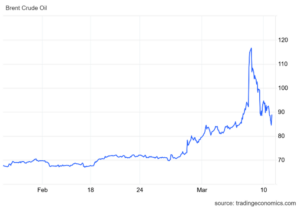
Goldman Sachs has estimated the current risk premium at roughly $14 per barrel, calibrated to their modelled impact of a sustained disruption to Strait traffic — not an open-ended catastrophe, but a meaningful supply shock.[v] OPEC+ has indicated willingness to release additional supply, and strategic petroleum reserves remain available as a policy tool.[vi] Alternative pipeline routes in the Gulf do exist, though their capacity is limited relative to normal Strait flows. The Strait has faced periods of tension before and while not officially closed, most international traffic has stopped.[vii]
For Canadian investors, higher oil prices are a double-edged sword: beneficial for energy producers and the TSX’s commodity-heavy sectors, but a headwind for consumers and a complicating factor for the Bank of Canada’s inflation outlook.
As we do not hold any sector-specific energy or geographic-specific Middle East equity funds, the impact to our client portfolios is contained to the periphery affects on energy prices. The current oil prices are currently pricing in a 3-4 week disruption to oil supply. A timely resolution would allow oil prices to normalize; a prolonged conflict would require a reassessment of the broader macro picture.[viii] We are watching developments closely and we will keep you informed as the situation develops.
Stock Markets
The most notable equity market story of Q1 has been the divergence between U.S. and non-U.S. stocks. The S&P 500, coming off three consecutive years of strong gains — 24%, 23%, and 16% respectively — entered 2026 at stretched valuations, and has had a more muted start to the year, affected by ongoing uncertainty around U.S. trade policy and tariffs. The index finished January slightly positive, but has since pulled back, and is tracking its weakest start to a year in three decades as of this writing.[ix]
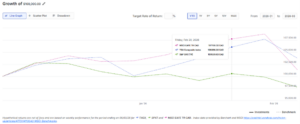
The TSX had a strong first two months of the quarter. The index hit an all-time record of 33,998 on February 23 and was up more than 6%year-to-date at that point, driven by gains in financials, technology, and mining. The energy sector and gold producers have provided an additional lift as the quarter progressed. The divergence from U.S. equities reinforces the value of maintaining a diversified, global portfolio — a lesson that the past several years of U.S. dominance had made easy to forget.
In terms of corporate earnings, the outlook remained constructive. Analysts were projecting year-over-year earnings growth of roughly 12% for S&P 500 companies in Q1, with full-year 2026 growth forecasts of approximately 15% — a strong backdrop for US equities, despite the valuation headwinds.
Despite the projected earnings growth in the US, we are slightly underweighting our US mega and large-cap allocations due to the amount of spending (and borrowing) that is related to AI as well as the high expectations around these companies to continue earning at the pace they have with currently little-to-no regulation of their products.
The Canadian Economy
Canada’s economy has been navigating a challenging but more resilient-than-feared environment. U.S. tariffs on sectors like steel, aluminum, and automotive components have weighed on exports and suppressed business investment, and the Bank of Canada has estimated that cumulative tariff impacts will leave GDP approximately 1.5% lower than it would otherwise have been by end of year.[x]
At the same time, domestic demand has held up. The consumer has remained relatively resilient, supported by the cumulative effect of 275 basis points in rate cuts delivered by the Bank of Canada since mid-2024. The unemployment rate has eased from a peak of 7.1% to 6.5%, and real wage growth is providing some support to household spending.[xi] The Bank held its policy rate steady at 2.25% at its January 28 meeting — a signal that monetary policy is now at neutral, and that the easing cycle is, for the time being, complete.[xii]
GDP growth for 2026 is projected at roughly 1.1% — modest, but positive. The upcoming CUSMA review remains a source of uncertainty for Canadian businesses.[xiii]
Currently, our Canadian equity exposure continues to focus on high-quality dividend-paying companies with durable earnings, less directly exposed to the trade volatility affecting manufacturing and resource export sectors.
International Markets: Europe & Japan
One of the more encouraging stories of the past year — and one that continued into Q1 — has been the sustained outperformance of international developed market equities. In 2025, non-U.S. developed markets outperformed their American peers by the widest margin since 1993, an underappreciated shift in a decade defined by U.S. dominance.[xiv]
Europe has benefited from attractive valuations, falling interest rates, and a meaningful increase in fiscal spending — particularly in Germany, which undertook a significant reset of its defence and infrastructure budget in 2025. The Euro Stoxx 50 entered 2026 with earnings growth expectations broadly comparable to the S&P 500, but at considerably lower valuation multiples — a combination that has drawn renewed international capital flows.[xv]
Japan’s investment case also continues to develop constructively. Corporate governance reforms, now a decade in the making, are steadily improving capital allocation and shareholder returns across Japanese boardrooms.[xvi] Wage growth has been positive for two consecutive years, and domestic consumption is gradually picking up. The Bank of Japan’s cautious path toward monetary policy normalization adds some currency risk to the equation, but we continue to view Japanese equities — particularly those with strong domestic earnings — as an attractive diversifier away from the concentrated U.S. technology trade.[xvii]
Over the last year, we have maintained selective exposure to both regions across client portfolios, and that positioning has served as a valuable ballast during the recent volatility in U.S. equities.
Artificial Intelligence
The AI investment cycle continued to advance at a notable pace through Q1. On February 25, Nvidia reported fourth-quarter revenue of
$68.1 billion, a 73% increase year-over-year, driven overwhelmingly by data centre demand from hyperscalers.[xviii] The result beat guidance by roughly $3 billion and underscored that the infrastructure buildout underpinning AI remains very much in full swing.[xix] Nvidia’s GPU Technology Conference (GTC), scheduled for March 16–19 in San Jose, is expected to showcase next-generation chip
architectures and a broadening set of agentic AI applications.[xx] In other words, the conference offers a peak into the next leg of potential productivity gains coming from AI.
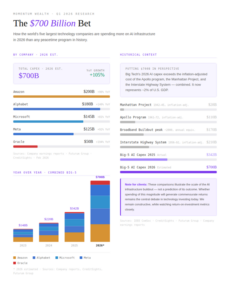
The major cloud providers — Microsoft, Amazon, Meta, and Google — are collectively tracking toward approximately $700 billion in AI infrastructure spending for 2026.[xxi] BlackRock’s Q1 equity outlook notes that AI is no longer just a U.S. story: the technology’s benefits are beginning to diffuse more broadly across sectors and geographies, and investment opportunities are widening beyond the original cohort of mega-cap technology companies.[xxii]
We remain constructive on AI as a long-term investment theme. Near-term volatility in technology stocks — whether from geopolitical uncertainty or valuation concerns — does not alter our view of the underlying transformation underway. We approach any pullbacks in quality names with measured interest.
The start of Q1 2026 has been a quarter of two halves in many ways: a constructive first two months that validated several of the themes we had been watching, followed by a late-quarter development that introduced new variables. At Momentum, we’ve managed through several such periods, from the US-China trade war of 2018, to the pandemic rollercoaster of 2020 to the rate shocks of 2022. Our approach remains the same: stay focused on quality, maintain diversification, and resist the urge to make reactive changes based on headlines.
References
[i] The Strait of Hormuz is the world’s most important oil transit chokepoint – U.S. Energy Information Administration (EIA)
[ii] Iran news: Crude oil prices near US$120
[iv] Brent crude oil – Price – Chart – Historical Data – News
[v] How Will the Iran Conflict Impact Oil Prices? — Goldman Sachs
[vi] OPEC+ agrees modest oil output boost even as US war on Iran disrupts shipments | Reuters
[vii] Iran warns oil tankers transiting Strait of Hormuz must be careful
[viii] Iran war and your portfolio: Historical stock market patterns — CNBC, Mar 4, 2026
[ix] S&P 500 Earnings Season Update — FactSet, Jan 16, 2026
[x] Structural change — Canada at a crossroads — Bank of Canada, Feb 2026
[xi] BoC done with rate cuts, expects 2% inflation to persist — RBC Economics, Dec 2025
[xii] Bank of Canada maintains policy rate at 2¼% — Bank of Canada, Jan 28, 2026
[xiii] Quarterly Economic and Trade Report: Winter 2026
[xv] European Stocks Rally to Record Highs on Strong Earnings
[xvi] global.morningstar.com/en-nd/markets/after-taking-breather-why-japan-stocks-could-keep-rising
[xvii] global.morningstar.com/en-nd/markets/after-taking-breather-why-japan-stocks-could-keep-rising
[xviii] Nvidia Q4 FY2026 Earnings — CNBC, Feb 25, 2026
[xix] https://www.blackrock.com/institutions/en-ca/insights/thought-leadership/equity-market-outlook
[xx] https://www.nvidia.com/gtc/conference-schedule/
[xxi] Barclays Global Research, “AI Infrastructure Capex Tracker: Hyperscalers Q4 2025 Update,” March 2026 (aggregated from Microsoft, Amazon, Alphabet, Meta filings)
[xxii] Equity Market Outlook Q1 2026 — BlackRock